
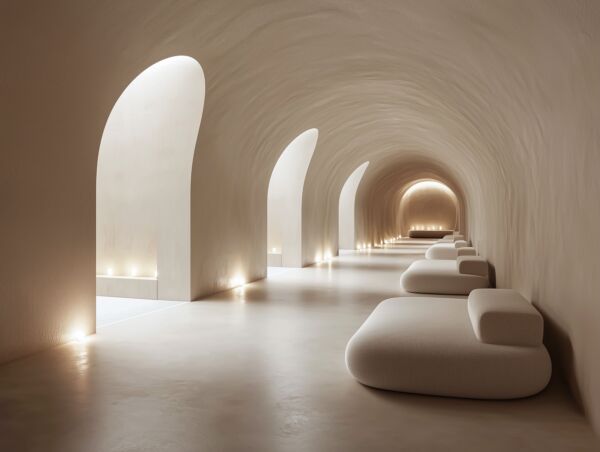
Roman clay walls bring depth to a room without relying on obvious patterns or glossy finishes. Their soft, mineral-like appearance changes gently as light moves across the surface, giving otherwise simple spaces more character. Roman clay wall ideas work especially well where you want warmth and movement while keeping the overall interior quiet and refined.
Why Roman Clay Creates More Depth Than Flat Paint
Standard paint usually produces a fairly uniform surface. Roman clay is applied in thin, overlapping layers, allowing subtle tonal variations and application marks to remain visible.
Those variations become part of the design. Instead of looking unfinished, they create the slightly weathered quality associated with old plaster walls, handmade finishes, and natural stone.
Let Lighting Do Part of the Work
Indirect daylight makes the finish especially noticeable. A wall near a large window may appear smooth from one angle and gently textured from another.
Soft wall sconces can produce a similar effect at night. Homeowners exploring broader interior design references can use the same principle with other matte finishes: texture often becomes more interesting when lighting arrives from the side rather than straight ahead.
Choose Colors With Natural Undertones
Warm neutrals are a natural match for Roman clay. Mushroom, putty, muted beige, clay brown, soft gray, and dusty taupe can all reinforce the material’s earthy character.
Color doesn’t have to be pale. Deep olive, charcoal, rust, and muted burgundy can turn a Roman clay wall into a dramatic architectural feature without producing the shine associated with lacquered accent walls.
Resources centered on cozy room planning can also provide broader inspiration when coordinating textured walls with softer fabrics, lamps, rugs, and furniture.
| Color Direction | Visual Effect | Works Well With |
|---|---|---|
| Warm beige | Calm and earthy | Oak and linen |
| Soft gray | Quiet and modern | Black accents |
| Olive | Organic and grounded | Walnut furniture |
| Charcoal | Dramatic and intimate | Brass lighting |
Where Roman Clay Makes the Strongest Impression
Large uninterrupted walls usually show the finish best. Living-room walls, bedroom headboard walls, dining areas, and entry halls give subtle tonal movement enough surface area to become visible.
Smaller applications can work too. A Roman clay fireplace surround, alcove, or reading nook can introduce texture without committing an entire room to the finish.
The material also pairs naturally with ideas found in outdoor-material inspiration, especially when interiors include stone, wood, terracotta, or other surfaces that visually connect indoor rooms with natural environments.
Balance Texture With Simpler Materials
Roman clay already creates visual movement, so surrounding finishes don’t need to compete with it. Smooth cabinetry, solid-color upholstery, simple curtains, and restrained artwork allow the wall finish to remain noticeable.
Wood adds warmth without introducing another busy surface. Metal creates useful contrast, while linen, wool, and cotton reinforce the soft matte character.
Use Restraint Around Architectural Details
Applying Roman clay across every wall can sometimes flatten its impact. One or two carefully selected surfaces may create more distinction.
Simple baseboards and clean trim also tend to work better than overly decorative moldings when the goal is relaxed contemporary character.
Common Roman Clay Design Mistakes
The biggest mistake is expecting Roman clay to look perfectly uniform. Minor variation is part of its appeal, and trying to eliminate every visible application mark can remove the handmade quality that makes the finish distinctive.
Another problem is combining it with too many competing textures. Heavily veined stone, busy wallpaper, patterned upholstery, and textured plaster in one small room can create visual noise. Let one or two materials carry most of the character.
Frequently Asked Questions
Is Roman clay suitable for every room?
It works well in many living spaces, bedrooms, entries, and dining rooms. Areas exposed to frequent splashes, heavy moisture, or repeated scrubbing may require a more durable surface treatment.
Does Roman clay make walls look rustic?
Not automatically. Warm colors and weathered furnishings can push it toward rustic design, while smooth furniture, contemporary lighting, and restrained colors create a modern appearance.
Can Roman clay work in small rooms?
Yes. Using it on one prominent wall or architectural feature can add depth without visually overwhelming a compact room.
Let the Finish Become Part of the Architecture
Roman clay works best when it isn’t treated as ordinary paint with extra texture. Consider how daylight, furniture, flooring, and nearby materials will interact with the wall before choosing the final tone. A carefully placed matte surface can give even a simple room a sense of age, softness, and handcrafted character without filling it with decorative clutter.

